
DTF Printing Services & Continuous Transfer Sheets
Engineered for apparel creators, streetwear brands, and commercial garment manufacturers across India. Get razor-sharp CMYK detail, 100% solid white ink backing, and superior elasticity on cotton, polyester, fleece, denim, and blended textiles.
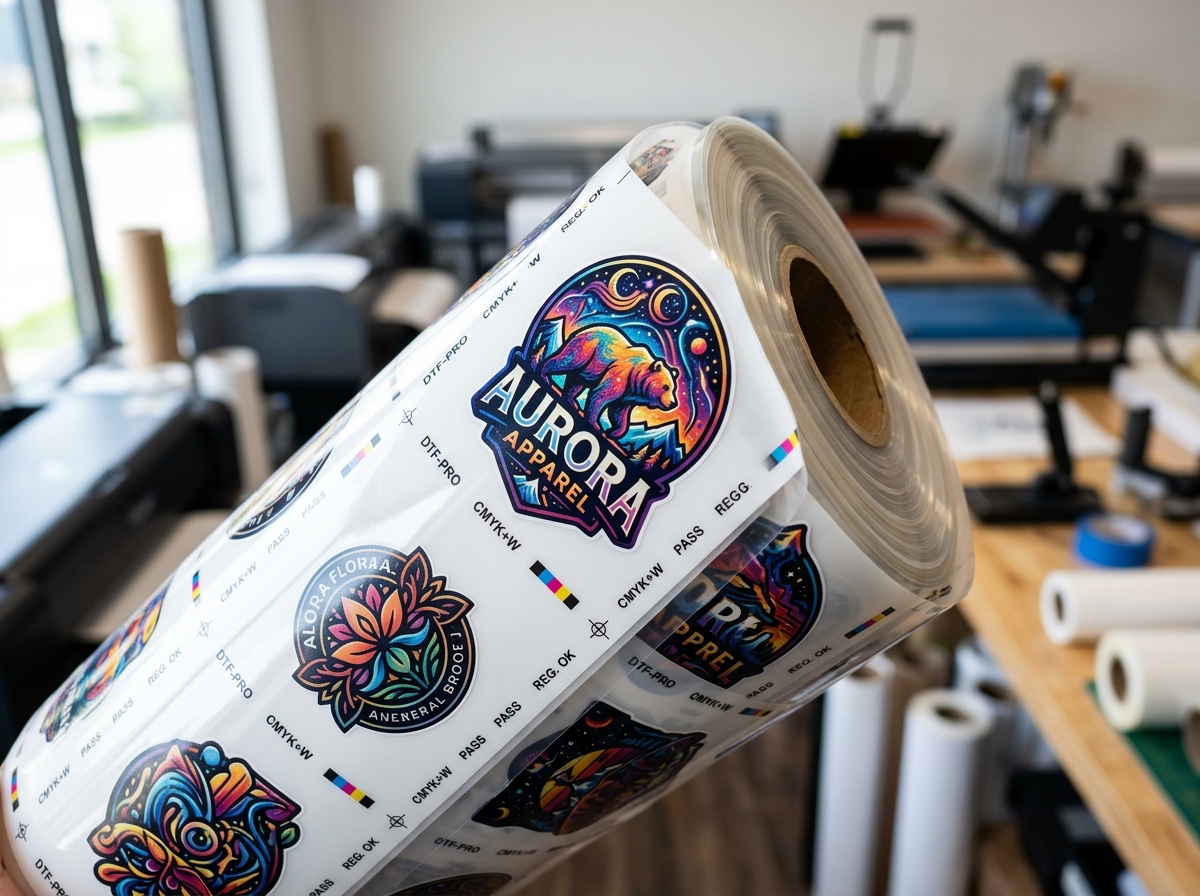
Direct-to-Film (DTF) printing is an industrial digital printing method where full-color CMYK graphics and a heavy-density white ink underbase are printed onto a coated polyethylene terephthalate (PET) transfer film, coated with thermoplastic polyurethane (TPU) adhesive powder, and heat-cured. The cured transfer is then permanently bonded to natural or synthetic fabrics using a heat press at 155°C–165°C for 12–15 seconds, delivering 50+ wash cycles of durability without cracking or color loss.
What is Direct-to-Film (DTF) Printing & How Does It Work?
Direct-to-Film (DTF) printing is an advanced digital textile transfer process that prints your graphic directly onto a coated polyethylene terephthalate (PET) carrier film. Unlike vinyl cutouts or traditional screen printing, DTF requires no screens, no manual weeding, and no color limits.
High-Chroma CMYK Deposition
Your artwork is rendered digitally using industrial micro-piezo printheads. Inks are deposited in micro-droplets (down to 3.8 picoliters), capturing smooth gradients, photorealistic skin tones, and intricate vector linework down to 0.5pt.
Automated White Underbase
A high-opacity white ink layer is deposited directly over the CMYK graphic. Our RIP software automatically chokes this underbase by 1 to 2 pixels, preventing any white halos from bleeding around colored edges, even on pitch-black cotton.
Pneumatic TPU Powder Shaker
While the ink is wet, fine thermoplastic polyurethane (TPU) adhesive powder is evenly applied. An automated mechanical shaker removes excess powder from non-printed areas, ensuring only the graphic receives adhesive.
Infrared Tunnel Polymerization
The powder-coated film passes through a temperature-controlled infrared baking tunnel. The TPU granules melt into a smooth, flexible elastomeric glue layer ready to bond into fabric fibers under standard heat press pressure.
Where Indian Clothing Brands & Manufacturers Use DTF
From limited streetwear drops to bulk industrial staff uniforms, DTF provides unmatched versatility across diverse apparel categories.
👕 D2C Streetwear & Fashion Brands
Print multi-color back graphics, chest typography, and inside collar size tags on 240+ GSM French Terry, oversized drop-shoulder tees, and acid-washed cotton without paying screen-setup charges per color.
🧥 Hoodies, Sweatshirts & Fleece
Heavy 380–450 GSM winter garments with textured surfaces pose problems for DTG and vinyl. DTF's flexible TPU adhesive bridges dense fabric fibers, remaining crack-free across cold-weather stretches.
🏃 Activewear & Polyester Blends
Standard prints on athletic poly-spandex crack during workouts. Our premium TPU adhesive flexes and returns with the fabric, resisting dye migration on performance jerseys and gym leggings.
💼 Workwear & Corporate Uniforms
Heavy cotton twill aprons, industrial polo shirts, chef jackets, and utility vests undergo frequent commercial laundering. Giggo DTF transfers resist 50+ washing cycles without lifting or fading.
👜 Canvas Bags, Caps & Accessories
Embellish promotional canvas tote bags, denim jackets, baseball caps, beanies, and fabric footwear. Transfers press effortlessly onto seam areas and curved platens that screen printers reject.
🔄 Screen Printing & Embroidery Resellers
Print shops and embroidery studios across Mumbai and India order continuous gang rolls from Giggo India, cutting down fulfillment overheads and pressing transfers on-demand as customer orders arrive.
DTF Fabric Compatibility & Press Guidelines
DTF transfers bond with nearly all natural and synthetic textile weaves. Here is our calibrated compatibility guide:
| Fabric / Substrate | Compatibility | Press Temp & Time | Peel Profile | Durability Expectation |
|---|---|---|---|---|
| 100% Combed Cotton | Optimal (100%) | 155°C (310°F) • 14 Seconds | Cold Peel (15s cool) | 50+ commercial wash cycles |
| 100% Polyester & Dry-Fit | Excellent (95%) | 145°C (295°F) • 12 Seconds | Cold Peel (Low heat prevents scorching) | 50+ wash cycles (anti-migration) |
| Cotton / Poly Blends (60/40, 50/50) | Optimal (100%) | 150°C (300°F) • 14 Seconds | Cold Peel | 50+ wash cycles |
| French Terry & Fleece (380+ GSM) | Excellent (95%) | 155°C (310°F) • 15 Seconds | Cold Peel + 5s Post-Press | 50+ wash cycles with high stretch |
| Denim & Heavy Canvas | Optimal (100%) | 160°C (320°F) • 16 Seconds | Cold Peel + Firm Pressure | 50+ rugged wash cycles |
| Nylon Windbreakers & Cordura | Good (Requires Test) | 140°C (285°F) • 10 Seconds | Cold Peel (Avoid coating degradation) | 35+ washes (waterproof coats may vary) |
Gang Sheet Layout & Artwork Submission Specifications
Follow these technical guidelines to ensure accurate color reproduction, razor-sharp details, and optimal roll yield.
1. Roll & Gang Sheet Dimensions
Our master roll is 60cm wide. The active printable graphic area is 58cm (22.8 inches). You can nest designs across any continuous running length from 1 meter up to 100 meters per roll.
2. Resolution & Sizing
All raster artwork should be provided at true 300 DPI at 100% target print size. Files prepared at 72 DPI from web previews will result in pixelated or blurry print outputs.
3. Transparent Backgrounds
Always submit files with transparent backgrounds (PNG, PDF, AI, PSD). Any white background box surrounding your graphic will be printed as solid white ink.
4. Color Space & Vector Fonts
Design in CMYK (U.S. Web Coated SWOP v2) for closest Pantone color reproduction. Convert all fonts and typography to outlines/curves to prevent substitution errors.
5. Minimum Line Weight
Maintain a minimum line thickness of 0.5pt (approx 0.2mm). Lines thinner than 0.5pt cannot pick up enough TPU adhesive powder, which may cause incomplete adhesion on fabric.
6. Right-Reading (Do Not Mirror)
Submit your gang sheets reading normally (right-reading). Our automated Raster Image Processor (RIP) handles all horizontal flipping and white underbase generation automatically.
Calibrated 4-Step Heat Pressing Parameters
Follow this calibrated 4-step workflow to guarantee 50+ commercial wash cycles with zero peeling.
Pre-Press Fabric
Press the garment alone for 5 seconds at 155°C (310°F) to remove ambient moisture, flatten loose fibers, and smooth surface wrinkles.
Primary Transfer Press
Position the DTF transfer sheet face-up on the garment. Press firmly at 155°C for 14 seconds with medium-high pressure (45–55 PSI).
Cool & Peel
Allow the garment to cool for 15–20 seconds until cool to touch. Peel the carrier film in a smooth, continuous diagonal motion without jerking.
Matte Post-Press
Cover the exposed print with silicone parchment paper and post-press for 5 seconds at 155°C. This locks ink into fabric fibers for a soft, wash-proof matte finish.
How to Order DTF Print Sheets Step-by-Step
We make ordering trade DTF rolls straightforward, fast, and transparent from initial file check to nationwide doorstep delivery.
Prepare Your Artwork
Assemble your logos, size tags, and graphics into a 58cm wide gang sheet at 300 DPI transparent PNG or vector PDF format.
Share via WhatsApp or Email
Send your files directly to our prepress trade desk on WhatsApp (+91 90296 36411) or email giggoindiastickers@gmail.com with total meters needed.
Prepress Review & Quotation
Our technicians inspect resolution, transparent margins, and white underbase choke. We share a digital layout proof and formal GST trade quotation within 30 minutes.
Industrial Roll Production
Upon approval, your job enters the print queue across our dual Epson i3200-A1 roll printers, automated powder shakers, and infrared curing tunnels.
Quality Control & Packaging
Every meter is inspected on backlit tables for ink density and powder melting uniformity, sealed in moisture-proof plastic, and packed into reinforced spiral postal tubes.
Pan-India Express Dispatch
Orders are dispatched within 24 to 48 hours via premium express air couriers (Bluedart, Delhivery, DTDC) with live tracking links sent to your WhatsApp.
Frequently Asked Questions About DTF Print Sheets
Practical answers to the most common questions from clothing brands, merchandise creators, and print resellers.
Our standard roll width is 60cm with an active printable graphic width of 58cm (22.8 inches). The running length can be customized from 1 meter up to 100 continuous meters per roll without any breaks.
Yes, absolutely! You can nest as many neck labels, sleeve prints, chest logos, and full back graphics as fit inside the 58cm width. We charge strictly per running meter, not per design or per color, giving you maximum cost efficiency.
No. Please send your graphics right-reading (do not mirror) with a 100% transparent background at 300 DPI. Our automated RIP software handles mirroring and generates a calibrated 100% white ink underbase choked by 1–2 pixels to avoid white border bleed.
When pressed following our 4-step parameters (155°C, 14 seconds, medium pressure, and a 5-second post-press), our transfers withstand 50+ domestic machine wash cycles at 30°C–40°C. The elastic TPU powder stretches with the fabric weave and will not crack or peel under normal wear.
Hot peel films allow the carrier sheet to be pulled immediately after pressing (within 2–3 seconds), which speeds up high-volume production. Cold peel films require waiting 15–20 seconds until the print is cool to touch before peeling, providing ultra-crisp edges on delicate micro-typography. We offer both options based on your production preference.
We have Zero MOQ. You can order as little as 1 running meter (58cm × 100cm) for sampling, collection testing, or small-batch drops before scaling up to wholesale roll volumes.
On a 58cm × 100cm (1 running meter) sheet, you can comfortably nest 45 to 50 left-chest logos (10cm × 10cm), or 12 to 14 standard A4 front prints, or 6 to 8 oversized streetwear back graphics (up to 38cm × 48cm). You can also tile small inside neck labels and sleeve emblems in between the larger prints to achieve 100% media efficiency.
The initial 14-second press transfers the ink film from the PET plastic to the fabric. However, the surface remains slightly glossy and sits on top of the weave. The mandatory 5-second post-press with parchment paper remelts the TPU adhesive, driving it deeply into the interlocked cotton or polyester yarn fibers. This eliminates the rubbery hand-feel, seals the edges, and ensures 50+ wash longevity.
Our prepress department uses X-Rite spectrophotometers and custom RIP color lookup tables calibrated to match the Pantone Formula Guide Solid Coated system with ΔE ≤ 2.5 on production runs. Simply specify your required PMS color codes in your order submission notes on WhatsApp.
Yes. For 100% polyester and sublimated sportswear garments, we recommend pressing at a slightly lower temperature (140°C–145°C for 12 seconds). Our high-opacity white ink layer acts as a barrier that minimizes dye sublimation migration from the garment into your graphic.
All rolls are sealed inside water-resistant poly sleeves with silica desiccant packs to prevent humidity exposure, then placed inside heavy-gauge spiral-wound cardboard postal tubes with reinforced plastic end caps to prevent crushing during transit.