
Sublimation Printing Services for Activewear & Hard Blanks
Where ink molecularly fuses with synthetic polymers. Under 210°C precision heat and pressure, solid dye gasifies directly into polyester yarn fibers. The resulting print has zero hand-feel, maximum moisture-wicking breathability, and lifelong resistance to cracking, fading, or peeling.
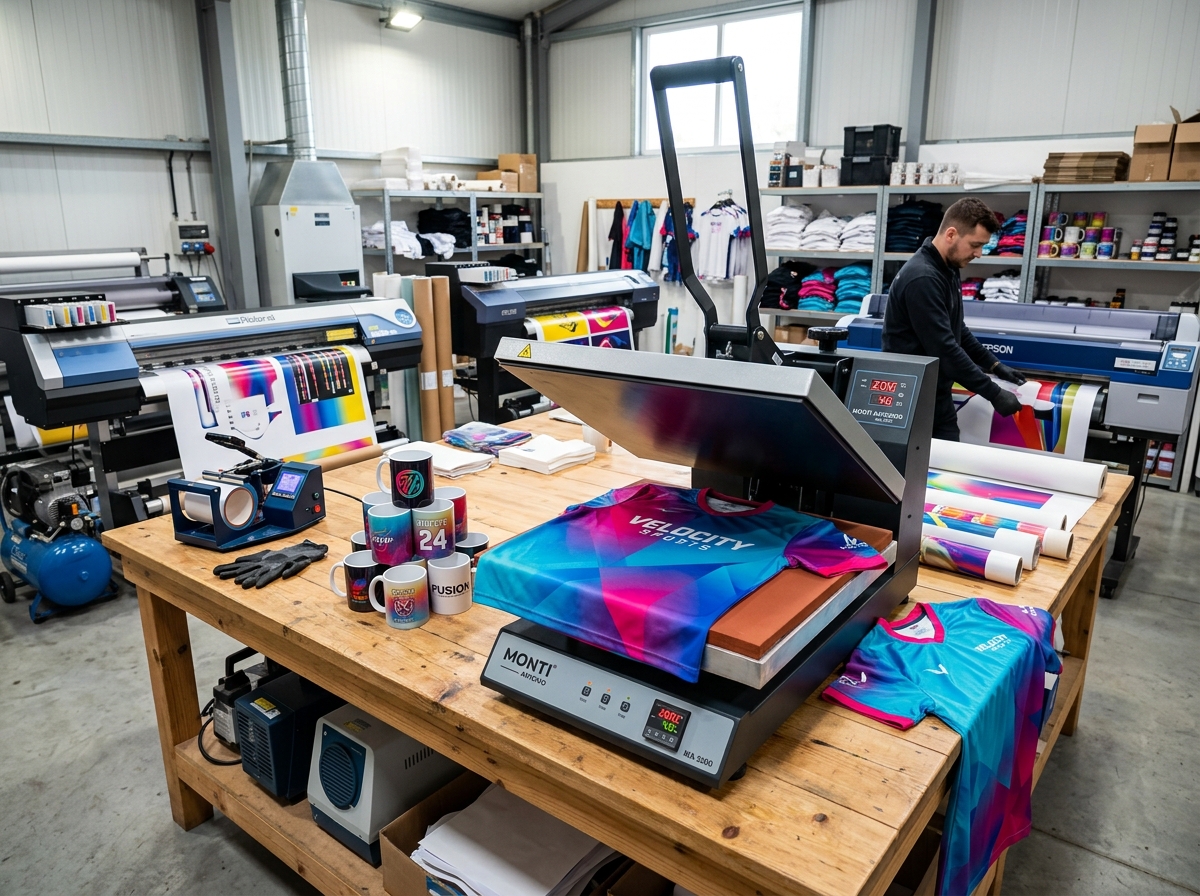
Dye sublimation printing is a high-temperature digital textile transfer process where solid disperse dye inks are printed onto specialized transfer paper and exposed to heat (205°C–210°C) and pneumatic pressure. Under these conditions, the dyes convert directly into a gas without entering a liquid phase, molecularly fusing into open synthetic polyester fibers. Upon cooling, the dye locks permanently inside the yarn, delivering 100% zero-feel, uncrackable, and fade-proof color with full fabric breathability.
How Dye Sublimation Works: The Science of Gas Infusion
Sublimation is a chemical phase change where disperse dye transitions directly from a solid state into a gas without turning into liquid.
High-Speed Disperse Ink Printing
Your artwork is printed in reverse onto coated sublimation transfer paper using high-density disperse dye inks. These dyes contain microscopically milled pigment crystals engineered to vaporize under thermal activation.
Pneumatic Heat Calender (210°C)
The printed paper and target polyester fabric are fed into an industrial rotary oil-drum calender operating at 205°C–210°C (400°F–410°F). Under extreme heat, the synthetic polymer fibers expand and open their molecular pores.
Molecular Dye Gasification
Simultaneously, the disperse dye turns into gas. The pressurized dye vapor penetrates deep into the opened polyester pores. When the fabric exits the calender and cools, the pores close, trapping the dye permanently inside the yarn.
True Zero-Feel Breathability
Because the dye becomes part of the fiber itself rather than a film layer resting on top, the fabric remains 100% breathable. Sweat evaporates naturally through the weave without causing sticky plastic patches.
Verified Supported Materials & Product Applications
Sublimation strictly requires polyester or specialized polymer receptor coatings. We process both apparel and rigid hard goods:
⚽ Sports Teamwear & Activewear
Football jerseys, marathon athletic tees, cycling bibs, cricket team kits, esports compression tops, and moisture-wicking gym apparel. Full all-over cut & sew print rolls.
🎫 Promotional Textiles & Lanyards
Custom trade show neck lanyards, satin event wristbands, microfiber cleaning cloths for eyeglasses, and oversized gaming desk mousepads with non-slip rubber bases.
☕ Coated Drinkware & Ceramic Mugs
Polymer-coated two-tone ceramic coffee mugs, white ceramic tea cups, polymer-glazed aluminum sports bottles, and stainless steel insulated travel tumblers.
🚩 Soft Signage, Flags & Lightboxes
Outdoor teardrop flags, feather advertising banners, retail exhibition backlit fabric displays, table runners, and conference backdrop banners with rich dye saturation.
🖼️ Metal Photo Panels & Plaques
ChromaLuxe-style polymer-coated aluminum photo plates and high-gloss award plaques with photographic depth, high contrast, and scratch resistance.
🛋️ Home Decor & Accessories
Printed satin cushion covers, polyester tote bags, decorative wall tapestries, and customized fabric bar runners for hospitality venues.
Sublimation Compatibility & Technical Limitations
To ensure complete transparency, here is what is compatible and what cannot be sublimated:
| Fabric / Substrate Type | Polyester % | Sublimation Result | Hand-Feel | Practical Recommendation |
|---|---|---|---|---|
| 100% Polyester (Dri-FIT, Micro-Poly) | 100% | 100% Full Chroma Saturation | True Zero-Feel (Breathable) | Gold standard for sports jerseys and activewear |
| Poly-Spandex / Lycra Blends | 85%–90% | Vibrant & Stretch-Proof | Completely flexible | Ideal for yoga wear, compression gear, and swimwear |
| Cotton-Poly Blend (50/50, 65/35) | 50%–65% | Vintage Faded / Heathered Look | Soft hand | Dye bonds only to poly fibers; cotton remains undyed |
| Polymer-Coated Hard Goods (Mugs, Metal) | Polymer Layer | High-Gloss Photographic | Smooth glazed finish | Requires factory-applied polyester/polymer clear coating |
| 100% Cotton (Garments / Tees) | 0% | Incompatible (Dye Washes Out) | N/A | Cotton fibers cannot open pores; Use DTF or DTG instead |
| Black & Dark Colored Textiles | Any % | Incompatible (Invisible / Muddy) | N/A | Sublimation inks have no white ink; Use DTF Sheets instead |
Artwork & Color Specifications for Sublimation
Achieve breathtaking color pop, precise vector lines, and smooth tonal transitions across your production runs.
1. White & Light Substrates Only
Sublimation inks are semi-transparent dyes with no white ink channel. The white color in your design is formed by the white fabric beneath. Always specify white or pastel fabric bases.
2. True 300 DPI File Resolution
Submit your activewear patterns, jersey vector numbers, and flag graphics at 300 DPI true scale in vector PDF, Adobe Illustrator (.AI), CorelDRAW (.CDR), or high-res TIFF.
3. All-Over Seam Bleed Allowances
For cut-and-sew jersey manufacturing, include a minimum of 15mm to 20mm perimeter bleed beyond the cutting pattern lines to accommodate fabric shrinkage during high-heat calender processing.
4. High-Vibrancy ICC Color Profiling
Our RIP station utilizes custom spectral ICC profiles for high-density disperse inks. We support fluorescent neon yellow, neon pink, and intense cyan accents that standard desktop printers cannot match.
How to Order Sublimation Printing Step-by-Step
Reliable trade fulfillment for activewear manufacturers, teamwear suppliers, and merchandise brands.
Share Your Design & Fabric Specs
Provide your graphic files, jersey patterns, or target product specs on WhatsApp (+91 90296 36411) with estimated quantity.
Prepress Review & Proofing
Our team verifies fabric composition, bleed margins, and color saturation, providing digital proofs and exact wholesale pricing.
Disperse Print & Heat Calender
High-speed roll printers produce transfer paper, which is thermally infused via our 210°C oil-drum calender into your fabric.
Inspection & Roll Packing
Rolls are inspected for uniform dye penetration, rolled with protective interleafing, and packaged in water-resistant sleeves.
Pan-India Express Dispatch
Dispatched within 24 to 48 hours via express air logistics (Bluedart, Delhivery, DTDC) with live WhatsApp tracking.
Frequently Asked Questions About Sublimation Printing
Clear, honest answers regarding fabric requirements, color durability, and production workflows.
Sublimation requires synthetic polymers to bond. Fabrics must contain at least 65% polyester, with 100% polyester (Dri-FIT, micro-poly, interlock, poly-spandex) delivering the most brilliant, vibrant results. It also works on polymer-coated hard goods like ceramic mugs and aluminum plates.
No. Natural cotton fibers do not have the polymer structure needed to trap disperse dye gas; the ink will completely wash out on the first laundry cycle. For 100% cotton apparel, we recommend our DTF Print Sheets or DTG Garment Printing instead.
No. Sublimation dyes are translucent and contain no opaque white ink. When applied to dark or black fabric, the dye is swallowed by the darker background and becomes invisible. For black or dark garments, choose our DTF Print Sheets, which feature a solid 100% white ink underbase.
Not at all. Because the dye molecularly fuses inside the polyester yarn fibers rather than creating a rubber or vinyl surface layer, the fabric's open weave remains 100% breathable. Sweat evaporates naturally through the fabric, making it the premier choice for marathon jerseys and intense athletic wear.
Sublimation prints last for the entire lifespan of the garment. Because the dye is chemically locked inside the synthetic fibers, it cannot peel, crack, flake, or wash away, even after 100+ industrial laundry wash cycles.
Yes. Our wide-format sublimation setups can deploy specialized high-chroma fluorescent neon inks (neon yellow, neon pink, neon green) for sports jerseys, safety vests, cycling apparel, and high-visibility athletic teamwear.
Our industrial roll-to-roll disperse printers accommodate fabric rolls up to 64 inches (162 cm) in width, supporting seamless all-over cut-and-sew jersey printing, oversized banners, and large-format trade show displays.
We offer Zero MOQ. You can produce sample meters or single prototypes to check color saturation and fabric drape before scaling up to wholesale manufacturing volumes.
We deploy high-release 70 to 90 GSM coated sublimation papers treated with quick-dry chemical layers. This prevents ink cockling, ensures over 95% dye transfer yield into the polyester weave during calender pressing, and leaves zero ghosting or cockling artifacts.
Because sublimation dye vaporizes into a gas, individual ink dots gently expand and merge at the microscopic fiber boundary. This natural optical continuous blending produces flawless, banding-free skin tones, continuous radial gradients, and atmospheric photographic depth unmatched by conventional screen-printed dots.