
UV DTF Printing Services & Custom Transfer Stickers
Transform any rigid or cylindrical product into branded luxury merchandise without heat presses or expensive screen setups. Our industrial UV DTF technology pairs high-density CMYK inks with a raised tactile 3D clear gloss varnish and permanent high-tack adhesive backing.
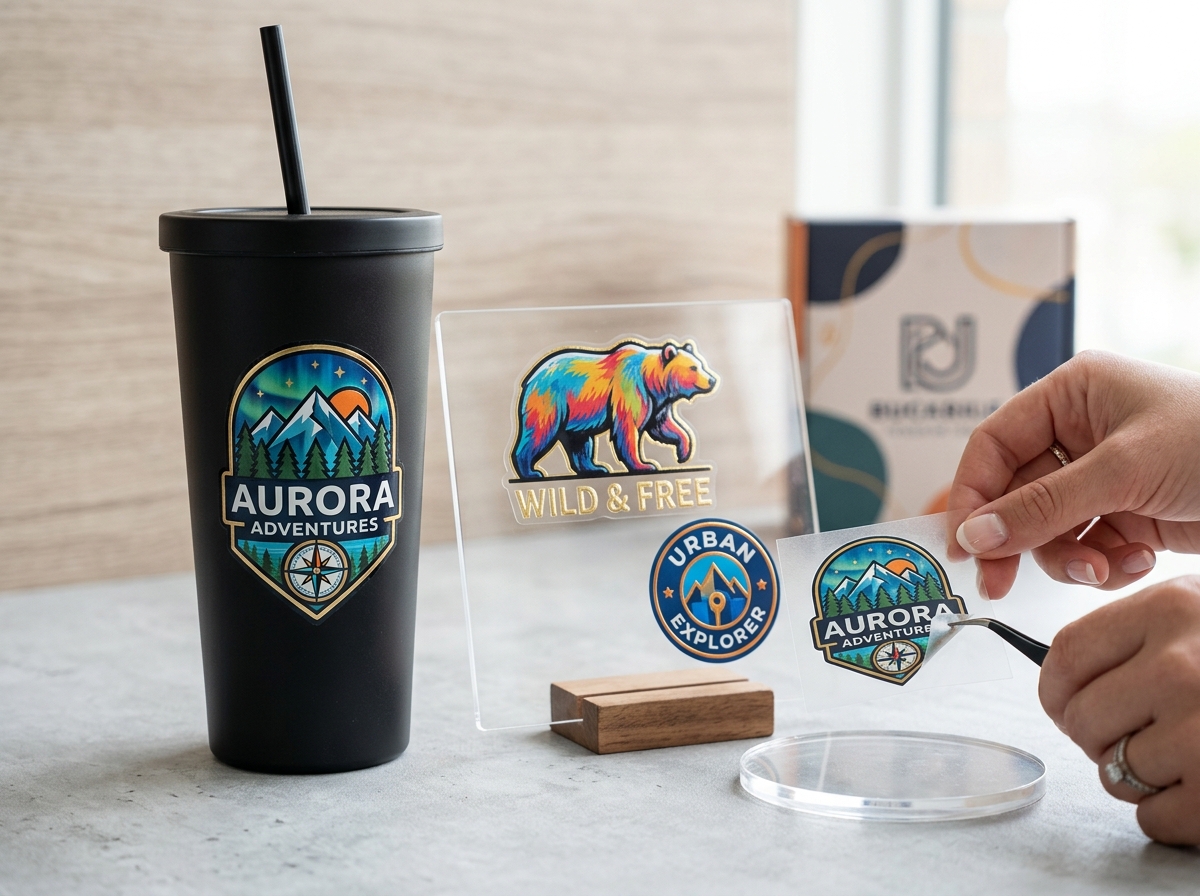
UV DTF (Direct-to-Film) printing—often called cold crystal peel transfer or 3D crystal stickers—is an industrial digital printing method where UV-curable CMYK inks, an opaque white underbase, and an embossed high-gloss clear varnish dome are printed onto a release carrier (Film A) and laminated with a transfer film (Film B). The sticker transfers at room temperature with simple thumb or squeegee pressure onto rigid substrates—such as stainless steel tumblers, acrylic, glass, and wood—with zero heat press, zero water, and zero weeding required.
What is UV DTF Printing & How Does Cold Transfer Work?
UV DTF (Ultraviolet Direct-to-Film) combines ultraviolet LED curing technology with dual-film transfer chemistry. It eliminates the traditional constraints of flatbed printers, screen printing screens, and vinyl cutters.
Film A Printing & UV-LED Curing
Artwork is printed onto release Film A. Industrial Epson i3200-U1 printheads lay down an adhesive base, high-density white underbase, photographic CMYK inks, and a heavy spot-varnish topcoat. Instant UV-LED lamps polymerize the ink droplets instantaneously.
Inline Film B Lamination
The printed graphic is automatically laminated with transparent transfer Film B using a heated pressure roller. This seals the graphic and prepares it as a self-adhesive, cold-transfer sticker ready for end-user application.
3D Tactile Lacquer Dome
Unlike flat paper labels, the clear UV varnish layer cures into a raised 3D domed finish that you can physically feel. It provides superior scuff resistance, water repellence, and defense against UV sunlight degradation.
Instant Cold Bond Adhesion
The transfer requires zero heat press, zero water slide soaking, and zero messy chemical sprays. Users simply peel the backing paper, burnish the sticker down with firm thumb pressure, and peel away the carrier mask.
UV DTF vs Textile DTF: What You Must Know
While both use transfer films, their chemistry, adhesives, and target substrates are entirely different.
UV DTF (Cold Hard Transfers)
Substrates: Glass, metal, stainless steel tumblers, acrylic, plastics, wood, ceramics, leather, laptops, electronic housings, automotive trim.
Application: Cold hand pressure only. Peel film A, rub down firmly with squeegee or thumb, peel clear transfer carrier B. Zero heat press required.
Texture: Raised, tactile glossy 3D embossed lacquer dome with diamond clarity.
Limitation: Not suitable for flexible fabrics or clothing (use Textile DTF for apparel).
Textile DTF (Garment Heat Transfers)
Substrates: 100% cotton, polyester, poly-cotton blends, fleece, French Terry, canvas bags, denim jackets, nylon.
Application: Requires heat press at 155°C (310°F) for 14s with medium-high pressure to melt TPU glue powder into textile weaves.
Texture: Flexible, smooth matte elastomeric textile feel that stretches with fabric movement.
Limitation: Cannot be applied to rigid items without melting or failing to adhere.
Realistic Product Branding Applications for UV DTF
UV DTF solves the challenge of branding curved, irregular, or oversized rigid items that cannot fit under flatbed machines or warrant rotary screen tooling.
🍺 Drinkware, Glassware & Cans
Glass beer cans, iced coffee tumblers with bamboo lids, mason jars, whiskey glasses, and ceramic mugs. Achieves crystal-clear transparency around fine logos without unsightly sticker borders.
🍶 Stainless Steel Flasks & Bottles
Insulated stainless steel travel tumblers, powder-coated gym shakers, and aluminum cycling bottles. Strong solvent adhesive resists moisture, condensation, and everyday handling.
💻 Laptops, Gadgets & Electronics
Custom branding on aluminum MacBook lids, ABS plastic phone cases, audio equipment, gaming mice, keyboards, and lithium power banks with millimeter precision.
🏆 Acrylic Signage, Awards & Badges
Corporate employee plaques, crystal trophies, QR code table stands for restaurants, conference name badges, and architectural directional signs with rich 3D gloss varnish.
🪵 Luxury Wooden Gifts & Boxes
Finished wooden presentation boxes, bamboo organizers, cigar humidors, and wooden luxury packaging lids where fine micro-lines transfer crisply across natural woodgrain.
🛠️ Industrial Equipment & Tooling
Equipment control panels, tool cases, electrical switchgear labeling, and asset identification tags requiring oil-resistant, chemical-resistant permanent surface branding.
Surface Compatibility & Preparation Guidelines
UV DTF adhesive performs best on smooth, clean, non-porous surfaces. Follow these preparation rules for maximum adhesion:
| Surface Material | Adhesion Performance | Preparation Requirement | Curing / Handling Tip |
|---|---|---|---|
| Smooth Glass & Borosilicate | Permanent (100%) | Wipe with 99% Isopropyl Alcohol | Full chemical cure in 24 hrs before water exposure |
| Stainless Steel & Powder-Coated Metal | Permanent (100%) | Degrease with dry microfiber wipe | High-tack bond withstands temperature changes |
| Cast Acrylic & Polycarbonate | Optimal (100%) | Clean with antistatic cloth | Instant peel; zero scratches on acrylic face |
| Finished & Sealed Solid Wood | Excellent (95%) | Ensure surface has lacquer/varnish seal | Rub firmly into grain valleys before peeling mask |
| Glazed Ceramics & Porcelain | Optimal (100%) | Remove dust and finger grease | Hand wash recommended for long-term luster |
| Raw Porous Concrete / Fabric / Silicone | Not Recommended | N/A — porous surfaces cannot create suction | Use Textile DTF for fabrics; avoid silicone coats |
UV DTF Artwork & Gang Sheet Setup Specifications
Prepare your files correctly to take full advantage of our multi-layer white underbase and raised gloss varnish channels.
1. Resolution & File Types
Submit artwork at 300 DPI true scale in vector PDF, Adobe Illustrator (.AI), CorelDRAW (.CDR), or transparent PNG. Keep text converted to curves/outlines.
2. Automatic Spot Varnish Mask
By default, our RIP software automatically covers 100% of your graphic with the clear 3D gloss varnish dome. If you want selective varnish (varnish only on specific logo elements), provide a dedicated spot channel labeled Spot_Varnish.
3. Minimum Line Width
Maintain a minimum stroke weight of 0.75pt (approx 0.3mm). Because UV DTF transfers rely on physical adhesive surface area, hairline details thinner than 0.75pt may detach when peeling the top carrier mask.
4. Gang Sheet Efficiency
Nest as many small logos, badges, and designs as possible onto your gang sheet. Leave at least 5mm between designs to allow easy cutting with scissors prior to object application.
How to Apply UV DTF Stickers in 30 Seconds
Follow this simple 4-step cold transfer protocol to guarantee permanent bonding without heat or specialized equipment.
Clean Surface Thoroughly
Wipe the target product with isopropyl alcohol or a grease-cutting cloth to remove dust, oil, and fingerprints. Allow to dry completely.
Peel White Backing Film A
Peel the white opaque backing film away, leaving the adhesive and 3D printed graphic on the transparent clear top transfer carrier.
Apply & Burnish Firmly
Position carefully onto the object (alignment is final once touched). Rub firmly from the center outward using your fingers, thumb, or squeegee to eliminate air pockets.
Peel Clear Transfer Mask B
Slowly peel the clear top carrier film flat against the surface at an acute 180° angle. The 3D embossed graphic bonds permanently to the product.
How to Order Custom UV DTF Printed Sheets
Rapid trade fulfillment for merchandise agencies, corporate gifters, and brand builders.
Send Your Gang Sheet or Files
Share your print-ready artwork on WhatsApp (+91 90296 36411) or email with dimensions and quantity of transfer sheets required.
Prepress Review & Proofing
Our technicians check resolution, vector line weights, and spot varnish masks to guarantee flawless peeling on production.
Multi-Layer UV-LED Printing
Your order is printed across high-precision industrial UV flatbed/roll lines with automated UV-LED curing and lamination.
Protective Flat/Tube Packing
Sheets are interleafed with anti-static release paper, placed in moisture-barrier bags, and packed flat in heavy card mailers or postal tubes.
Tracked Pan-India Dispatch
Dispatched within 24 to 48 hours via premium express air logistics (Bluedart, Delhivery, DTDC) with real-time tracking.
Frequently Asked Questions About UV DTF Printing
Detailed answers to common questions about durability, application techniques, and ordering requirements.
UV DTF stickers adhere permanently to virtually all smooth, hard, non-porous surfaces. This includes borosilicate glass, ceramic mugs, stainless steel tumblers, acrylic signs, ABS plastic phone cases, aluminum plates, varnished wood, smooth leather, and coated cardboard. They do not adhere to fabrics or unsealed porous materials.
No equipment is needed. UV DTF is a 100% cold transfer technology. You only need your hands or a simple squeegee. Peel backing Film A, rub firmly onto your product, and peel clear mask B. The sticker bonds immediately with room-temperature pressure.
UV DTF transfers have exceptional water resistance, scratch resistance, and UV sunlight tolerance once fully cross-linked (approx 24 hours after application). While top-rack domestic dishwashing on glass or stainless steel is possible, hand washing with a soft sponge is always recommended to maintain the high-gloss lacquer luster over long-term commercial use.
We recommend a minimum line thickness of 0.75pt (0.3mm) and a minimum font height of 6pt. Because the graphic must hold enough adhesive surface area to overcome the peel tension of the clear carrier mask, ultra-thin hairline vectors or free-floating micro-dots may fail to transfer cleanly.
Yes. You can gang as many different logos, shapes, client badges, and color variations as fit on your gang sheet. We price based on sheet area or running length, not per logo, maximizing your production yield.
Conventional vinyl decals require manual cutting and weeding of negative space, leaving thick plastic borders and limited colors. UV DTF prints multi-color halftones directly with an automated spot-varnish dome and zero weeding. Only the printed ink and varnish transfer to the substrate, creating a premium directly printed look.
Initial mechanical adhesion occurs immediately upon burnishing. However, the high-tack solvent acrylic adhesive reaches maximum chemical cross-linking bond strength after 24 hours. We advise waiting 24 hours before subjecting branded drinkware to water or intensive friction.
We maintain Zero MOQ. You can order a single sheet for prototyping, product photography, or market validation before committing to bulk commercial runs.
Thoroughly clean the tumbler with 99% isopropyl alcohol first. Peel the backing film A, anchor only one edge of the graphic against the curved cylinder, and progressively roll the transfer onto the surface with your thumb working outward in one direction. Burnish firmly with a felt-edge squeegee before peeling clear carrier B at a flat 180-degree angle.
For standard full-gloss stickers, our prepress software can automatically apply a matching varnish overlay. If you desire selective spot gloss (e.g., raised logos with matte backgrounds), create a separate vector layer or spot color channel named Spot_Varnish set to 100% fill.
Yes. Once the acrylic adhesive completes full cross-linking (24 hours after application), the cured polymeric ink and varnish layer resists incidental contact with hand sanitizers, 70% ethyl alcohol wipes, dishwashing soaps, and motor oils. Only prolonged immersion in pure acetone or lacquer thinner will degrade the adhesive bond.