
Quick Answer: UV DTF is better than vinyl when you want a premium, raised, scratch-resistant print on hard surfaces like glass, steel bottles, acrylic or packaging, with no visible sticker edge. Vinyl is better for large sizes, outdoor signage, vehicles and low-cost bulk labels. UV DTF typically costs more per piece; vinyl is cheaper per square foot.
Key Takeaways
- UV DTF transfers only the printed design (no background film), so it looks "printed on". Vinyl always leaves a visible sticker sheet or cut edge.
- UV DTF has a hard, glossy, slightly raised varnish layer that resists scratches and water. It suits bottles, tumblers, diaries and gift boxes.
- Vinyl wins on size, flexibility and price. It is the default for signage, car graphics, wall decals and big label runs.
- In India, printed vinyl is typically ₹15–₹50 per sq ft, while UV DTF is usually priced per sheet or per piece and costs more per square inch.
- Neither is truly dishwasher-proof. Hand washing extends the life of both.
- Pick UV DTF for small, premium, hard-surface branding; pick vinyl for big, outdoor or budget work.
What is the difference between UV DTF and vinyl stickers?
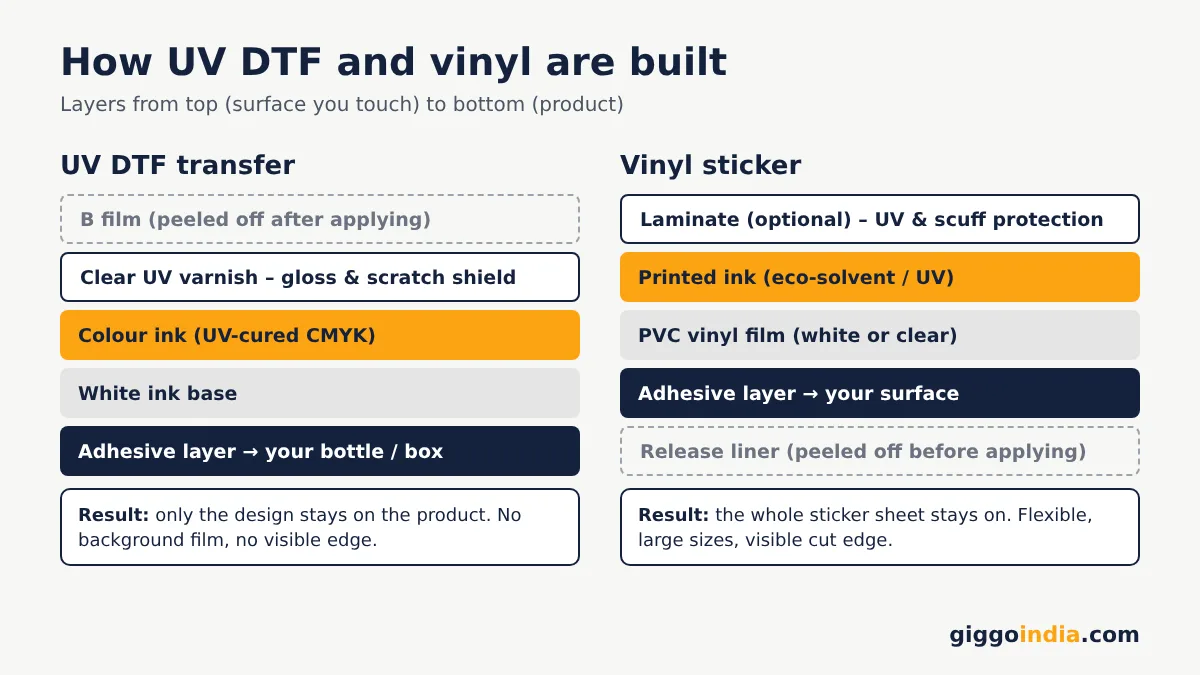
UV DTF is a transfer; vinyl is a sticker. UV DTF prints the design with UV-cured ink, white ink and varnish onto a film, then moves only the design to your product. Vinyl prints (or cuts) the design onto a self-adhesive PVC sheet that stays on the surface.
That one difference drives everything else: look, feel, durability and cost.
How a UV DTF transfer is made
A UV printer lays down white ink, colour and a clear varnish on an "A film" coated with adhesive. A UV lamp cures it instantly. A "B film" is laminated on top to protect it.
To apply, you peel the A film, press the design onto the surface, rub firmly and peel the B film away. No heat press, no water. What stays is just the artwork, with a slightly raised, glossy finish. We covered this in more detail in our UV DTF stickers guide.
How a vinyl sticker is made
Vinyl stickers are printed on eco-solvent or UV roll printers onto white or clear self-adhesive vinyl, often laminated, then contour-cut. The whole printed sheet sticks to the surface.
There are two main grades. Calendered vinyl is cheaper and suits flat surfaces. Cast vinyl is thinner, conforms to curves and lasts longer outdoors.
UV DTF vs vinyl: side-by-side comparison
| Factor | UV DTF transfers | Vinyl stickers |
|---|---|---|
| What sticks to the product | Only the printed design | Full sticker sheet or cut shape |
| Look and feel | Glossy, slightly raised, "printed-on" | Flat; matte, gloss or clear finish |
| Scratch resistance | High (cured varnish layer) | Medium; lamination improves it |
| Water resistance | Waterproof; hand-wash recommended | Waterproof when laminated |
| Best surfaces | Hard, smooth: glass, steel, acrylic, ABS, wood, coated paper | Almost anything flat or curved, including car body and walls |
| Fabric / soft surfaces | Not suitable | Not suitable (use DTF for fabric) |
| Maximum practical size | Small to medium (typically up to A3 or roll width) | Very large (banners, wraps, signage) |
| Outdoor life | Months to about a year in direct sun | Typically 3–5 years calendered; 7–10 years cast (manufacturer ratings) |
| Removal | Permanent; may leave residue | Easy to remove, some grades are removable |
| Typical India pricing | Per sheet or per piece; higher per sq inch | ₹15–₹50 per sq ft for printed vinyl |
| Ideal for | Bottles, tumblers, diaries, gift boxes, premium labels | Signage, vehicles, wall decals, bulk product labels |
Is UV DTF more durable than vinyl?
Indoors and on hard surfaces, yes. Outdoors in full sun, vinyl usually lasts longer.
UV DTF has a cured varnish layer on top of the ink, so keys, nails and daily handling barely mark it. That is why it is popular on steel bottles and office diaries that get thrown in bags.
Outdoor sunlight is a different test. Avery's own UV DTF FAQ rates its UV DTF stickers for outdoor use for up to a year and notes that long sun exposure can gradually dull colours (Avery UV DTF FAQ).
Good vinyl is built for that job. Manufacturer data for ORACAL films puts calendered vinyl at roughly 3–6 years and cast vinyl at 7–10 years of rated outdoor life for unprinted film (Sign Warehouse comparison). Printed vinyl lasts less unless laminated.
Are UV DTF and vinyl stickers waterproof?
Both are water-resistant, but neither should go in a dishwasher regularly. UV DTF handles daily washing of a bottle or mug by hand. Laminated vinyl handles rain and spills. Hot dishwasher cycles and harsh detergents shorten the life of both.
Which is more scratch resistant?
UV DTF. The raised varnish acts like a hard coat. Unlaminated vinyl can scuff and its edges can lift with handling. If you need scratch-resistant labels on small products, UV DTF is the safer choice.
Is UV DTF cheaper than vinyl?
No. Per square inch, vinyl is almost always cheaper. UV DTF uses costlier inks, varnish and two films, and is printed on smaller-format machines.
How the market typically prices them in India:
- Printed vinyl: Large-format printers commonly list ₹15–₹50 per sq ft for standard printed vinyl, with reflective, clear or premium grades higher (IndiaMART vinyl printing listings). Small die-cut sticker runs cost more per piece because of cutting and weeding.
- UV DTF: Usually sold per A4/A3 sheet or per piece. Listings range widely, from a few rupees per small logo in bulk to a few hundred rupees per A4 sheet for short runs.
What actually decides your cost is size, quantity and number of designs. Many small logos ganged on one UV DTF sheet can be very economical. A single large graphic is cheaper in vinyl.
GST also applies. Printed labels are generally taxed at 18% under HSN 4821, but confirm the exact rate on your invoice for your product type.
For exact pricing on your design, share your artwork and quantity with us on WhatsApp.
When should you choose UV DTF?
Choose UV DTF when the product is small, hard and premium, and you want the logo to look printed, not stuck on.
Good fits:
- Steel and glass bottles, tumblers and mugs for corporate gifting
- Diaries, notebooks and pen boxes with a raised logo
- Gift hampers and rigid boxes for Diwali and wedding season
- Candle jars, cosmetic jars and D2C packaging where you want a no-label look
- Phone covers, laptops and helmets (smooth, hard areas)
- Short runs with many designs, such as names for each employee
UV DTF also works without any equipment at your end. You receive ready transfers and apply them by hand.
When should you choose vinyl?
Choose vinyl for anything large, outdoor, curved over a big area, or very price-sensitive.
Good fits:
- Shop signage, glass door graphics and one-way vision films
- Vehicle branding and bike stickers
- Wall decals and event backdrops
- High-volume product labels on rolls
- Temporary or removable promotions
Which works better on bottles, glass and packaging?
For bottles and glass, UV DTF usually looks better; for long rolls of packaging labels, vinyl or paper labels are more economical.
On a steel bottle, a vinyl sticker shows a clear edge and can lift at the curve over time. A UV DTF transfer sits flush with no background, which is why it has become popular for corporate bottles in India.
For packaging, it depends on volume. A few hundred premium jars suit UV DTF. Tens of thousands of labels on an automatic line suit roll vinyl or paper labels.
How to decide in 4 steps
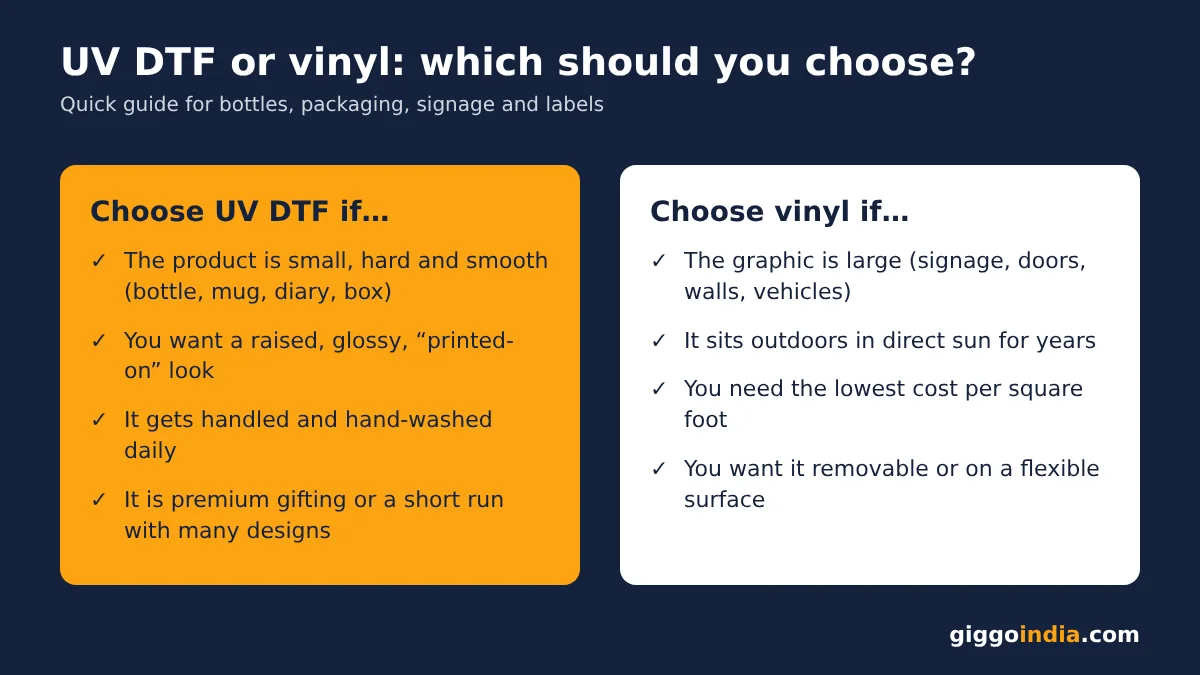
- Check the surface. Hard and smooth? UV DTF works. Large, rough or outdoor? Vinyl.
- Check the size. Under A4 per design favours UV DTF. Big graphics favour vinyl.
- Check the exposure. Daily handling and washing favour UV DTF. Years of direct sun favour cast vinyl.
- Check quantity and budget. Premium gifting favours UV DTF. Lowest cost per piece favours vinyl.
Ordering in India: MOQ, turnaround and shipping
Most UV DTF jobs are flexible on quantity because many designs can be ganged on one sheet. Turnaround is typically a few working days after artwork approval. Ready transfers are flat and light, so they ship easily by courier across India.
Plan ahead in October–November and the wedding season, when gifting orders peak and print queues get longer. Share your deadline when you ask for a quote.
Explore our UV DTF Printed Sheets service or see how UV DTF transfers are made and applied.
Frequently Asked Questions
Is UV DTF better than vinyl stickers?
UV DTF is better for small, premium branding on hard surfaces such as bottles, glass, acrylic and gift boxes. It looks printed-on and resists scratches. Vinyl is better for large graphics, signage, vehicles and outdoor use, and it is cheaper per square foot. The right choice depends on surface, size and budget.
How long do UV DTF stickers last?
On indoor items like diaries, boxes and hand-washed bottles, UV DTF can last a long time, often years, if applied firmly on a clean surface. Outdoors in direct sun, expect colours to dull within months to about a year. Avoid dishwashers and abrasive scrubbers to extend life.
How long do vinyl stickers last outdoors?
It depends on grade. Manufacturer ratings put calendered vinyl at roughly 3–6 years and cast vinyl at 7–10 years outdoors for unprinted film. Printed vinyl lasts less unless it is laminated. Hot Indian summers and monsoon humidity can shorten these figures.
Are UV DTF stickers waterproof?
Yes, UV DTF transfers are water-resistant and handle daily hand washing well, which is why they are used on bottles and tumblers. They are not designed for repeated hot dishwasher cycles or microwaves. They are also for external decoration only and should not touch food directly.
Can UV DTF be used on t-shirts or fabric?
No. UV DTF is made for hard, non-porous surfaces. For t-shirts, hoodies and fabric, use regular DTF transfers, which are applied with a heat press and stretch with the garment. Vinyl heat-transfer films exist too, but DTF is the usual choice for full-colour designs.
Can UV DTF stickers be removed?
UV DTF is meant to be permanent. You can scrape it off hard surfaces like glass or steel, but it may leave residue or damage delicate finishes. If you need a sticker that peels off cleanly, choose a removable vinyl grade instead.
Which is cheaper for 500 small logo stickers?
For many small logos, both can be economical. Vinyl usually wins on plain flat labels. UV DTF can be competitive when logos are ganged tightly on sheets, and it gives a premium raised finish. Share your size and quantity on WhatsApp for an exact comparison.
Is GST charged on printed stickers in India?
Yes. Printed labels and stickers are generally billed at 18% GST under HSN 4821, though classification can vary by product. Registered businesses can usually claim input tax credit. Always check the rate shown on your tax invoice.
Ready to choose?
If you are branding bottles, diaries, boxes or packaging and want a clean, premium finish, UV DTF is likely the right pick. For signage, vehicles or big label runs, go with vinyl.