
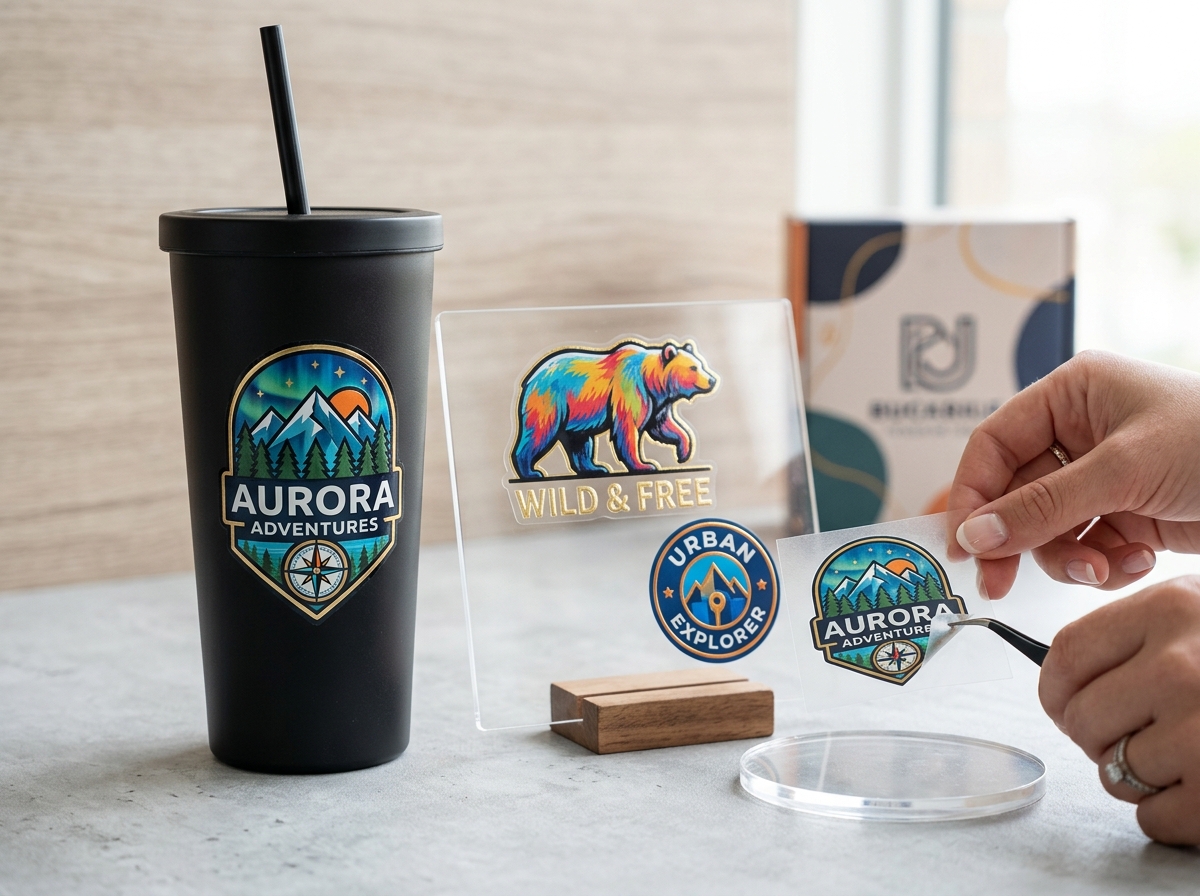
In the promotional merchandise, consumer packaging, and personalized gifting industries, branding rigid, curved, or irregular three-dimensional products has historically been a logistical bottleneck. Traditional methods—principally pad printing and rotary silkscreening—impose severe limitations: mandatory plate/die setup costs, strict minimum order quantities (MOQs), and an inability to reproduce photographic color gradients without visible halftone dot patterns.
The arrival of UV DTF (Direct-to-Film) printing—often called cold crystal peel transfer or 3D crystal label printing—has fundamentally disrupted this paradigm. By decoupling the digital printing process from the physical substrate, UV DTF allows brand owners, corporate gifting distributors, and trade print brokers across India to apply full-color, embossed, high-gloss branding to virtually any rigid product without owning a heat press, rotary jig, or multi-station screen line.
1. The Mechanical Architecture of a UV DTF Transfer
To understand why UV DTF transfers adhere so aggressively to non-porous hard surfaces, one must examine the multi-layer chemical and mechanical construction of the transfer sheet:
- A-Film (Base PET Carrier): A dimensionally stable polyethylene terephthalate sheet coated with a high-tack, UV-sensitive acrylic adhesive layer and silicone release backing.
- High-Opacity White Underbase: Printed directly on the adhesive layer, a heavy-viscosity white UV ink ensures that CMYK colors remain vivid and lightfast even when applied over matte black tumblers or dark anodized metal.
- CMYK Color Pigments: Industrial piezoelectric printheads deposit micro-droplets of pigmented UV inks cured instantly by dual high-intensity LED UV lamps at 395nm wavelengths.
- Gloss / Varnish Overcoat (Spot 3D Embossing): A clear polymeric varnish layer deposited directly over the color image. By depositing multiple varnish passes, technicians create tactile 3D embossed textures ranging from 15 to 40 microns in relief, delivering a luxurious raised finish that rivals hot-stamped badges.
- B-Film (Positioning Transfer Carrier): After UV curing, the printed sheet is laminated with a pressure-sensitive transfer tape (B-Film). When peeled on-site, the B-Film lifts the cured ink and adhesive cleanly away from the A-Film for flawless manual positioning.
Zero Heat, Zero Pressure Presses Required:
Unlike textile DTF transfers (which require 160°C heat presses to melt hot-melt polyurethane powder), UV DTF is a 100% cold transfer process. It utilizes high-cohesion pressure-sensitive adhesive that bonds instantaneously at room temperature upon burnishing with a squeegee.
2. Substrate Suitability & Surface Preparation Protocols
While UV DTF is exceptionally versatile, achieving permanent industrial adhesion requires matching the transfer to suitable substrates and executing rigorous surface prep:
- Drinkware & Vacuum Flasks: Matte powder-coated stainless steel, bare stainless steel, double-wall insulated tumblers, ceramic coffee mugs, and borosilicate glass bottles.
- Electronics & Gadgets: Polycarbonate (PC) and ABS plastic power banks, aluminum laptop enclosures, Bluetooth speaker housings, and smartphone cases.
- Signage & Display: Cast acrylic plaques, trophy awards, brushed aluminum composite panels (ACP), tempered glass display panels, and PVC boards.
- Premium Packaging & Gifting: Rigid luxury paperboard boxes, wooden tea chests, polished stone coasters, and bonded leather diaries.
Surface Degreasing: The Golden Rule
The primary reason for UV DTF adhesion failure is microscopic surface contamination: finger oils, silicone mold-release residues, or packaging dust. Before positioning a transfer, thoroughly wipe the substrate with a lint-free microfiber cloth saturated in 99% Isopropyl Alcohol (IPA). Allow 15 seconds for complete flash evaporation before applying the transfer. Note: Low-surface-energy plastics like untreated untreated polypropylene (PP) or polyethylene (PE) may require flame treatment or adhesion promoter primer.
3. UV DTF vs. Traditional Branding Technologies: Engineering Comparison
Commercial buyers often evaluate whether to run corporate orders via UV DTF, traditional pad printing, rotary screen printing, or direct flatbed UV. The table below outlines real-world manufacturing differences:
| Technology | Tooling / Setup Cost | Min. Economic Order | Curved / 3D Objects | Color Gradients | Tactile 3D Relief |
|---|---|---|---|---|---|
| Giggo India UV DTF | ₹0 (100% Digital) | 1 Sheet (Gang sheet) | Exceptional (Hand applied) | Photographic 1440 DPI | High (Varnish Emboss) |
| Pad Printing | ₹1,500 - ₹3,500 / color (Cliché dies) | 500+ units | Good (Silicone pad) | Poor (Flat spot colors) | None (Flat ink film) |
| Rotary Silkscreen | ₹1,200 - ₹2,500 / screen | 1,000+ units | Cylindrical only (bottles) | Coarse halftones | Low (Puff inks only) |
| Direct Flatbed UV | ₹500 - ₹1,500 (Jig fabrication) | 25 - 50 units | Limited by printhead clearance (<100mm) | Photographic 1440 DPI | High (Direct Varnish) |
4. Step-by-Step Manual Application: Zero-Bubble Technique
Applying UV DTF transfers does not require specialized industrial machinery, but following a disciplined technique ensures zero air bubbles, perfect edge alignment, and permanent cohesion:
- Clean and Degrease: Wipe the target surface with 99% Isopropyl Alcohol using a lint-free cloth. Allow 15 seconds to fully evaporate.
- Pre-Burnish the Transfer: Place the UV DTF transfer sheet on a flat table with the clear B-Film facing up. Firmly scrape the design from center outward with a felt-edge squeegee. This activates the mechanical adhesion between the B-Film transfer tape and the top varnish layer.
- Peel the A-Film Backing: Gently peel the white/clear backing film (A-Film) at a sharp 180-degree angle. Verify that all fine text and intricate graphic elements remain affixed to the clear transfer film.
- Position One Edge: Align the transfer over the target product. Anchor one edge or corner first. Do not drop the entire transfer sheet flat at once, which traps air pockets.
- Progressive Roll Application: Slowly roll the transfer onto the surface using your thumb or a squeegee, working consistently from the anchored edge to the opposite side to evacuate air.
- Firm Squeegee Pressure: Firmly rub down the entire graphic multiple times, paying special attention to micro-lettering, sharp corners, and thin graphic strokes.
- Cold Peel Release: Starting from one corner, slowly peel the clear B-Film away at a flat 180-degree angle against the surface. The cured ink and varnish will remain bonded to the product.
5. Industrial Durability: Scratch, Chemical & Wash Testing
Commercial clients demand rigorous durability data before approving transfers for promotional merchandise. Here are verified laboratory and field performance parameters for Giggo India UV DTF sheets:
- Scratch & Abrasion Resistance: Rated at 3H–4H pencil hardness upon full adhesive polymer cross-linking (24 hours post-application). Normal fingernail scratches, car key contact, and bag rubbing will not gouge or peel the transfer.
- Waterproof & Condensation Stability: Impervious to cold water immersion, iced beverage exterior sweating, and tropical ambient humidity.
- Chemical Resistance: Resistant to splash contact with mild dishwashing liquids, hand sanitizers, motor oil, and 70% ethanol. Prolonged immersion in pure acetone or industrial solvents will degrade the acrylic adhesive.
- Dishwasher Guidance: UV DTF transfers withstand repeated gentle hand washing with non-abrasive sponges. However, commercial dishwashers operating above 65°C with aggressive alkaline caustic detergents and high-pressure steam jets will gradually weaken edge adhesion over time. For maximum product longevity, hand-washing is strongly recommended.
6. Artwork File Preparation for UV DTF Gang Sheets
To maximize print sharpness and ensure precise spot white and spot varnish alignment, follow our prepress guidelines:
- Color Mode: Supply artwork in CMYK mode (FOGRA39 or SWOP v2) at 300 true DPI resolution.
- Spot White Channel (Spot_White): Vector artwork should include a dedicated spot color channel named
Spot_Whiteset to 100% opacity beneath all colored pixels. - Spot Varnish Channel (Spot_Varnish): If selective tactile embossing is desired, define a spot channel named
Spot_Varnish. Full-coverage varnish will protect the entire sticker; selective varnish highlights specific logos or text. - Minimum Line Weights: For standalone text without background adhesive film, maintain a minimum stroke weight of 0.5mm (approx 1.5pt) to ensure sufficient adhesive surface area.
Frequently Asked Questions: UV DTF Crystal Stickers
Can UV DTF stickers be applied to curved or irregular items?
Yes. Unlike flatbed UV printers that require objects to sit beneath a moving gantry with less than 2mm to 5mm vertical variance, UV DTF transfers are completely flexible transfer films. They can be applied smoothly by hand to cylindrical tumblers, conical mugs, helmets, and contoured vehicle components.
Do UV DTF stickers require a heat press or UV lamp to cure on the product?
No. UV DTF transfers are 100% cold peel transfers. The UV curing happens exclusively inside our industrial printer in Bhiwandi during production. Once you receive your sheets, they apply at standard room temperature simply with manual squeegee burnish pressure.
How do UV DTF transfers compare with standard vinyl cut decals?
Vinyl decals require mechanical plotter cutting, tedious manual weeding of tiny counter-spaces, and cannot reproduce photorealistic continuous gradients or 3D raised tactile varnish. UV DTF prints complete multi-color graphics with embedded white underbase and raised varnish directly, with zero weeding required.
What is the standard turnaround time for trade UV DTF gang sheets?
Standard print orders received before 2:00 PM IST with print-ready PDF/TIFF files are produced and dispatched from our Bhiwandi facility within 24 to 48 business hours via major air and surface express couriers across India.
Explore our dedicated service capabilities on our UV DTF Printed Sheets service page, compare direct flatbed printing on our Flatbed UV Printing page, browse completed corporate branding runs in our Portfolio showcase, or contact our Bhiwandi technical team for sample sheets.